
What happens when a wallet shows you exactly what a transaction will change—and what it still can’t protect you from? For DeFi power users managing multiple chains, high-value approvals, and frequent interactions with unfamiliar contracts, the promise of “no blind signing” is a decisive product claim. Rabby Wallet, the DeBank‑backed, open‑source multi‑chain wallet, built its identity around that capability. This article breaks down how Rabby achieves simulation and risk scanning, compares its trade-offs with mainstream alternatives, surfaces limits that matter in practice, and gives a compact decision framework for which wallet to use for which task.
The audience here is the experienced DeFi operator in the US: you care about transaction-level visibility, hardware-wallet anchoring, institutional workflows (multi‑sig, custody), and realistic failure modes. I assume familiarity with basic wallet concepts (seed phrases, approvals, gas) but not with the internal mechanics of pre‑sign checks and simulation engines. Read on for a sharper mental model of what simulation actually buys you, where Rabby stands relative to MetaMask and custodial wallets, and the concrete behaviors you should adopt to reduce risk.
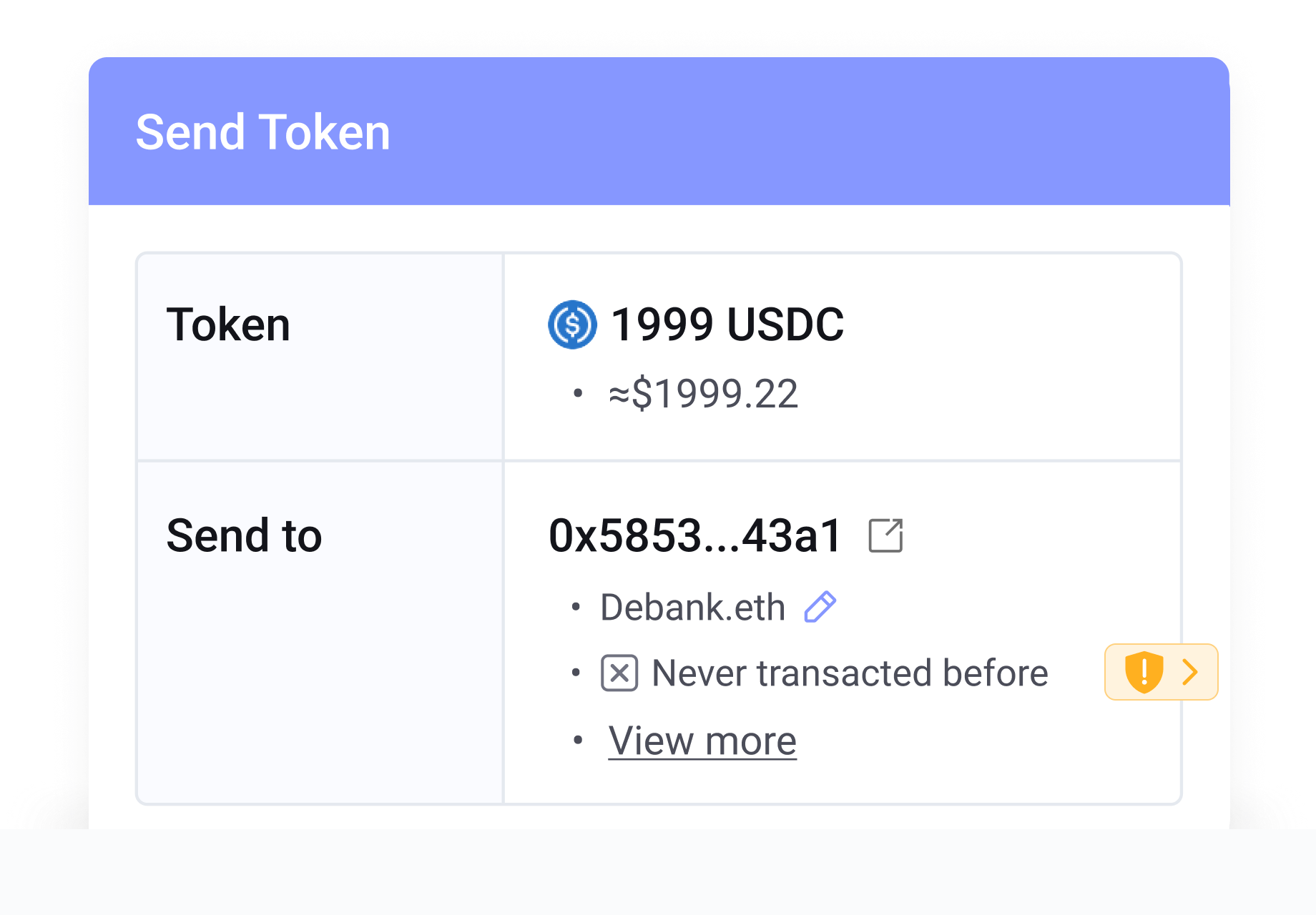
How Rabby’s simulation and pre‑transaction scanning work — mechanism, not marketing
At the core, Rabby’s value proposition is a two‑step safety barrier: (1) simulation, which computes the expected state changes (token flows and fee estimates) that will occur if you sign and broadcast the transaction, and (2) a security engine that flags heuristics and historical risk signals (e.g., known exploitable contracts, suspicious unlimited approvals, or nonexistent destination addresses). Mechanistically, simulation replays the transaction against node or local EVM logic to estimate post‑tx balances and revert conditions. The security engine layers policy rules and indicators over that simulation output.
Why this matters: blind signing—approving a contract without knowing the exact effect—remains one of the most common human vectors for loss. Seeing quantitative delta on token balances turns an opaque approval into an inspectable event. For example, instead of “approve 0xABC…” you see: token X balance goes from 100 → 0 after the call. That mapping of action → outcome is the key cognitive shift; it shifts decisions from trust‑based (do I trust the UI?) to evidence‑based (do I accept this precise balance change?).
But simulation is not a panacea. It depends on accurate node state, correct decoding of contract ABI and internal calls, and the assumption that on‑chain replay faithfully predicts on‑chain execution (gas price front‑running, mempool order changes, or deferred oracle updates can change outcomes). Rabby’s scanning engine reduces false negatives by incorporating historical compromise lists and suspicious patterns, but it cannot stop zero‑day exploits in an unrelated contract called by the transaction, or off‑chain social‑engineering that convinces you to sign a benign‑looking but malicious payload.
Side‑by‑side: Rabby versus MetaMask and custodial alternatives — trade-offs and best matches
Comparing wallets in DeFi is a multi‑dimensional choice: security model (non‑custodial vs custodial), UX friction, feature set (simulations, approvals revocation, cross‑chain tools), and ecosystem integrations. Below are the core differences that should shape your selection.
Rabby — Strengths: built‑in transaction simulation and pre‑transaction risk scanning, automatic network switching for over 90 EVM chains, robust hardware‑wallet support (Ledger, Trezor, Keystone, etc.), open‑source MIT license, native approval revocation, portfolio aggregation across chains, and integrations for multi‑sig and institutional custody (Gnosis Safe, Fireblocks). These features make Rabby well suited for active DeFi traders, arbitrageurs, and teams that need a local, auditable, non‑custodial client with enterprise touchpoints.
Rabby — Weaknesses and limits: no native fiat on‑ramp (you’ll need to use an external exchange or service to buy crypto), no in‑wallet staking primitives (you must use dApp interfaces), and dependency on accurate simulation inputs—meaning unusual contracts or dynamic on‑chain conditions can still lead to surprise outcomes. There is also historical baggage: a 2022 Rabby Swap contract exploit (~$190k) shows that product code and surrounding contracts are attack surfaces; the team froze the contract and compensated users, but the incident illustrates a broader point: even wallets with strong pre‑tx checks can be linked to contracts that require additional scrutiny.
MetaMask — Strengths: extremely broad adoption, deep dApp compatibility, and a familiar UX for many users. Weaknesses: it lacks Rabby’s pre‑transaction simulation by default (though third‑party tools can fill that gap) and historically exposes users to blind‑signing risks unless they adopt additional practices. For wallet flipping and day‑to‑day dApp work, MetaMask is still convenient, but it places more behavioral demands on the user to adopt scanning routines.
Custodial wallets/exchanges — Strengths: fiat rails, customer support, and insurance mechanisms in some cases. Weaknesses: custody risk, limited composability (can’t sign transactions directly into arbitrary DeFi contracts), and weaker privacy. Custodial offerings are sensible for on‑ramps and passive holdings but are a poor fit if you need direct multi‑chain signing, hardware anchoring, or granular approval control.
Myth vs. reality — three common misconceptions corrected
Myth: “A simulation that shows safe outputs guarantees safety.” Reality: Simulation reduces a class of human errors by clarifying expected outcomes, but it cannot prevent all technical or economic attacks. Time‑of‑execution differences, oracle manipulation, or dependent contracts introduce execution vectors outside the simulator’s predictive scope.
Myth: “Open‑source wallets are automatically safer.” Reality: Open‑source code increases transparency and auditability, which is valuable, but security depends on active audits, responsible disclosure processes, and the broader ecosystem of contracts you interact with. An open codebase does not immunize you from a poorly secured third‑party contract called by a transaction.
Myth: “Hardware wallets remove the need for vigilance.” Reality: Hardware devices secure private keys against extraction, but they do not make the decision for you. If you blindly approve an approval that allows a malicious contract to drain funds, the hardware wallet will faithfully sign it. The combination of hardware signing plus pre‑tx simulation is the stronger posture Rabby offers.
Practical heuristics: when to prefer Rabby and how to configure it
Use Rabby when you: make frequent multi‑chain transactions; sign approvals for high‑value tokens; require hardware‑backed signatures; operate within multi‑sig or institutional workflows; or need portfolio visibility across many chains. Configure Rabby to always show detailed simulation output before any approval, enable the approval revocation tool and review large unlimited approvals regularly, and integrate your hardware wallet for high‑value keys.
When Rabby may not be the best fit: if you rely on direct fiat purchases inside your wallet or want native staking dashboards, a custodial provider or dedicated staking interface will be more convenient. For pure casual holding, the overhead of simulation checks may feel like friction rather than benefit.
Decision framework — a short checklist for DeFi power users
When choosing a wallet for a specific task, ask: What is the maximum single‑transaction loss I’m willing to accept? Do I require air‑gapped or hardware signing? Am I interacting with unfamiliar contracts or token approvals? Do I need built‑in cross‑chain gas management? If your answers skew toward low tolerance for loss, frequent contract interactions, and cross‑chain activity, prioritize a wallet with transaction simulation, hardware‑wallet support, approval revocation, and institutional integrations—features Rabby offers.
What to watch next — near‑term signals and unresolved questions
Watch for three signals that could materially change the balance among wallets: (1) adoption of universal transaction simulation standards (e.g., widely used replay/test frameworks), (2) broader support for on‑chain attestations that can certify contract audits or verifications into wallet UIs, and (3) deeper integration of custody solutions with local simulation for hybrid institutional workflows. None of these are certain; they are conditional pathways where a wallet that already prioritizes simulations and enterprise integrations may gain further advantage.
Also watch for evolving mempool dynamics and MEV (miner/extractor value) strategies: if mempool manipulation becomes more common, simulation alone will be less predictive. That would push wallets toward additional protections such as private‑relay submission or built‑in sandwich/MEV mitigations.
FAQ
Is Rabby available on my devices and browsers?
Yes. Rabby is accessible as a browser extension for Chromium‑based browsers (Chrome, Brave, Edge), a mobile app for iOS and Android, and a desktop client for Windows and macOS. Choose the client that fits your workflow; the extension is convenient for fast dApp work, while the desktop client can be preferable for institutional setups.
Can Rabby prevent every kind of scam or exploit?
No. Rabby reduces many common risks by simulating transactions and scanning for known bad indicators, but it cannot prevent novel smart‑contract bugs, off‑chain social engineering, or execution‑time manipulation. Use hardware wallets, limit unlimited approvals, and revoke approvals regularly to layer defenses.
How does Rabby fit with hardware wallets and multi‑sig setups?
Rabby integrates with major hardware wallets (Ledger, Trezor, Keystone, CoolWallet, GridPlus, BitBox02) and supports institutional multi‑sig and custody integrations like Gnosis Safe, Fireblocks, and Amber. This makes it suitable for both individual power users and small institutional teams seeking non‑custodial control with enterprise features.
Where can I safely download Rabby and learn more?
For a simple entry point and downloads, the project provides documented links and guides—one accessible resource is the rabby wallet page. Always verify downloads against official release checksums and prefer browser extension stores or the official desktop/mobile channels to avoid malicious imitations.
Takeaway: simulation changes the cost‑benefit calculation of signing transactions by converting a trust decision into an evidence check, but it does not eliminate technical uncertainty. For active DeFi players in the US who need multi‑chain reach, hardware anchoring, and institutional compatibility, Rabby presents a pragmatic combination of features—each with clear trade‑offs. Use it to reduce human error, but pair it with hardware signing, a cautious approval habit, and an understanding of where simulation’s predictive power ends.